• lpubanner-lpdotcom

King Of Europe

#MiaSanMia

King Of Europe

Thanks opa Jupp, super bayern, super bayern!

King Of Europe

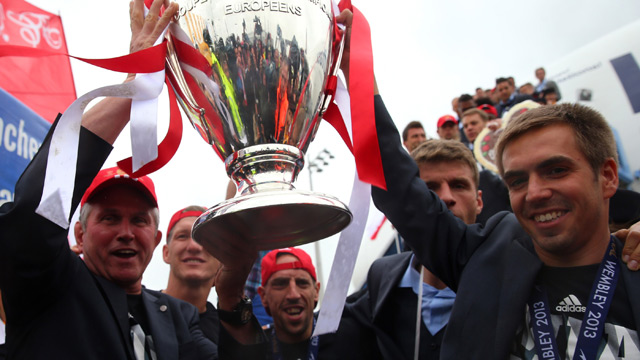
Celebration of Bayern! SUPER BAYERN!!

King Of Europe

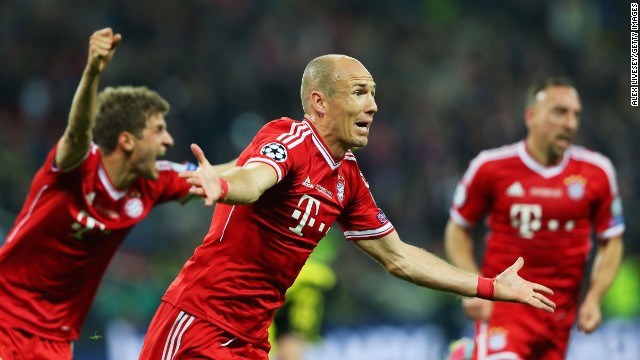
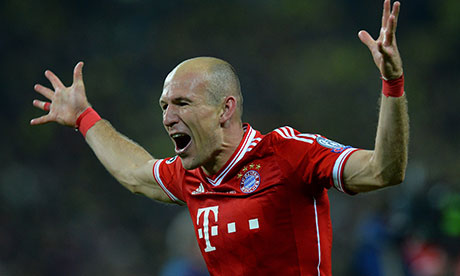
GOLLL!! ROBBEN...! SUPER BAYERN!!

Tampilkan postingan dengan label FC Bayern. Tampilkan semua postingan

Selasa, 28 Mei 2013

Ukraine midfielder Anatoliy Tymoshchuk to leave Bayern Munich at end of Bundesliga season

MUNICH - Ukraine midfielder Anatoliy Tymoshchuk says he will leave Champions League winner Bayern Munich at the end of the season.
Bayern chairman Karl-Heinz Rummenigge says Tymoshchuk has told the club he will reveal his destination after the German Cup final on Saturday in Berlin. Bayern plays Stuttgart and can complete an unprecedented treble for a German club.
Tymoshchuk has spent four seasons in Bayern and has mostly played a back-up role.

Bayern Munich wins all-German Champions League final at Wembley

champions league robben
Finally a winner … Bayern Munich's Dutch midfielder Arjen Robben. Photograph: Andrew Yates/Getty
In the red corner: the Germans. In the yellow corner: also the Germans. As widely predicted it was a Champions League final awash with swagger, towel-draping lederhosen fanatics and – above all – dimly conceived off-field cliches as Bayern Munich beat Borussia Dortmund 2-1 at Wembley to become champions of Europe. Arjen Robben, who missed a penalty in last year's final, scored the winning goal in the 88th minute. Elsewhere, Barcelona reacted to talk of power shifts, new eras, thousand-year footballing Reichs and the like by signing next-big-thing Neymar from Santos. And in domestic matters, Crystal Palace won the Championship play-off final and will play in the Premier League next season.

Bayern Munich chairman thinks they can win DFB Pokal while still a bit drunk

With the Bundesliga and Champions League winner's medals already around their necks, Bayern Munich just have the DFB Pokal final against Stuttgart left to win to complete the treble. The final match of Bayern's season comes six days after their Champions League success in London. Though some might worry about a potential lack of focus after the much deserved parties that followed their Champions League win, Bayern chairman Karl-Heinz Rummenigge isn't one of them.
Around 1 a.m. the night Bayern beat Borussia Dortmund 2-1 at Wembley, Rummenigge said a few words at the club's victory party and gave everyone reassurance that they would have a chance against Stuttgart even if they're still a bit drunk.
From FCBayern.de:
[Assistant manager] Hermann Gerland has said: ‘Party time!’ Yes, open fire. I know we have another final in six days, but I think we still have a chance even with 1.8 mg [blood alcohol level]!
(Applause)
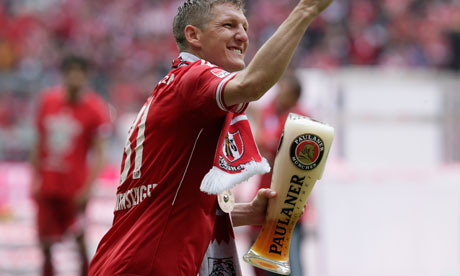
I wish you all the best! Have a great party! And let's listen to Bastian Schweinsteiger: drink plenty! Because today we’ll party till dawn, and tomorrow we’ll go home after a night without sleep. Thank you!"
Actually, Bayern — the club that won the Bundesliga by a 25-point margin this season — being drunk might even up the cup final against 12th-place Stuttgart. But just to prove how difficult it would be to play while that inebriated, Bild had a reporter dribble a ball while wearing goggles that simulate a blood alcohol level of 1.5 mg and the result was rather sloppy (video here).

Senin, 27 Mei 2013

Bayern Munchen come back to Munich

Bayern munchen come back to Munich... 

Champions League winners Bayern Munich return to Germany – video

Robert Lewandowski set to join Bayern Munich, claims agent

Robert Lewandowski after the Champions League final
Robert Lewandowski after the Champions League final. Photograph: Tom Jenkins
Borussia Dortmund striker Robert Lewandowski is likely to join German rivals and newly-crowned Champions League winners Bayern Munich, the Pole's agent said on Monday.
However, Cezary Kucharski told Polish local news channel TVN24 that Bayern had yet to agree terms for Dortmund's top scorer.
"For us it is clear, but we have not signed anything," Kucharski said. "The clubs need to reach an agreement." Kucharski gave no further details, but said they should emerge within three weeks' time.
After the Champions League win over Dortmund on Saturday, Bayern's outgoing coach Jupp Heynckes hinted at Lewandowski's possible transfer. "We know Mario Götze will be joining us and I don't think Lewandowski will be hanging about too much either," Heynckes said at the post-match press conference.
The 24-year-old striker said after Saturday's game that he was only thinking of resting for a few days and then joining Polish team-mates for their World Cup qualifier against Moldova on 7 June. "I'll be back in Dortmund a little after that," Lewandowski said. "I'll go to the national team and then we'll see what happens."

Minggu, 26 Mei 2013

Bayern Munich, Champion of Germany, Adds European Title


LONDON — Some saw this as the opening to an age of German soccer dominance, and maybe it will be. Maybe years from now Saturday’s Champions League final between Bayern Munich and Borussia Dortmund will be viewed as the start of the Bundesliga’s rise to the pinnacle of European sports.
But even if it isn’t, even if it turns out that two English teams or two Spanish teams play for the championship next year in Lisbon and the Bundesliga continues to lag behind the Premier League in popularity, there will always be this game. This night. This classic.
The British call a final like this a showpiece, and on a perfect night at Wembley, it was. There was tension. There was passion. There was wizardry and precision and players who seemed ready to run forever. There was, in the end, redemption.
It was fitting: Arjen Robben, the Dutch wing who had been roundly criticized for struggling in the biggest moments, starred in the most critical sequence of all, scoring the decisive goal for Bayern in the 89th minute and lifting the Bavarians to a 2-1 victory in front of a crowd announced at 86,298. Robben’s goal was also the perfect symbol for Bayern’s collective measure of payback as it reversed the crushing defeat it suffered to Chelsea in last year’s final at home.
The finish was sublime. After slipping behind the Dortmund defense, Robben took a pass from Franck Ribéry, eluded a defender and then coolly flicked the ball past Dortmund goalkeeper Roman Weidenfeller. Last year, Robben missed a critical penalty kick in the loss to Chelsea; this year, he was off running before the ball even crossed the goal line, sprinting toward the Bayern fans with his eyes wide and shaking his hands with glee.
Robben, who also lost the World Cup final with the Netherlands in 2010, said he nearly saw his career flash before him as he celebrated. “You don’t want the label of loser, you don’t want that tag,” he said afterward, cradling his award as the man of the match.
“This is a dream,” he said.
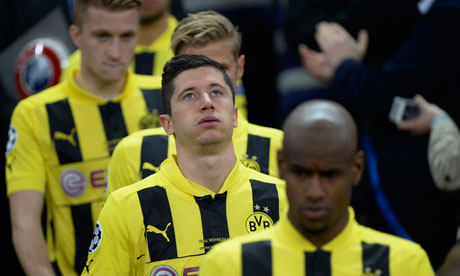
At the final whistle, many of the Dortmund players collapsed to the ground. They played Munich four previous times this season and could never do better than two draws, but on this day they played as if they believed they could pull off a huge upset, despite making only the second European final appearance in club history.
“We’re proud to have given Bayern a real game tonight,” Weidenfeller said. “We played well, but it wasn’t meant to be.”
Instead, it was Bayern, the German juggernaut, that won its fifth European title, sending off Coach Jupp Heynckes in the best possible manner. Heynckes, 68, will be replaced by the former Barcelona coach Pep Guardiola next year, but even the Spanish master will have trouble topping Heynckes’s final season: Bayern won the Bundesliga in record fashion, claimed the Champions League over its rival and could add the German Cup with a win in the final next week.
Guardiola will take over this summer, and talk of a Bayern dynasty will begin long before he sets foot in Germany.
“It’s quite possible that a new era in Europe might have begun,” Heynckes said.
Heynckes also noted that Guardiola will take over a “perfectly functioning team,” and it would be hard to argue otherwise. Bayern is a monolith, with financial resources that allow it to poach players when necessary, including Dortmund’s star forward Mario Götze, who did not play in the final because of an injury. Heynckes also indicated that Dortmund’s Robert Lewandoski would most likely come to Munich as well.
Given that, Dortmund’s future is less certain. Dortmund is known as more of a scrappy underdog, though that label is not altogether accurate. While the team may well lose some of its players, the club is hardly downtrodden. In terms of revenues, Dortmund is the 11th-biggest club in Europe, and its image — which is rooted in passionate fans, a team motto of “Echte Liebe” (True Love) and fluorescent bumblebee-themed uniforms — makes it a trendy choice for German neutrals. That its coach, Jurgen Klopp, is of the quirky-genius mold surely helps.
Klopp, though, was clearly distraught late Saturday. He praised Bayern and Heynckes, but also wondered aloud what would have happened if the referee, Italy’s Nicola Rizzoli, had sent off Dante after the Bayern defender put his foot into Marco Reus’s stomach in the 68th minute.
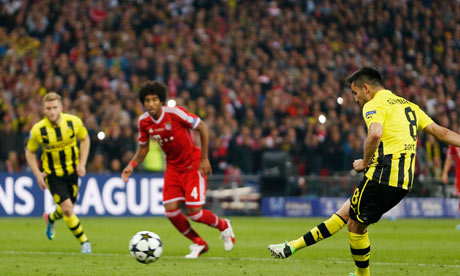
Rizzoli awarded Dortmund a penalty kick, which Ilkay Gündogan converted to tie the score at 1-1, but Rizzoli did not show Dante, who was booked in the first half, a second yellow card and subsequent red for the reckless foul.
“Maybe if it is 11 against 10 we get the winner,” Klopp said. He added that he was proud of his team but that, at that moment, “it’s the disappointment that prevails.”
“If you’re looking forward to something and you don’t get it, it hurts,” he said.
The final came at the end of a week that featured plenty of typical English weather — cold, dank and windy with the occasional fit of rain — and a slow buildup to the game itself. By Saturday, though, the air was warm and the sky was clear, allowing the German fans to roam the streets near Westminster and Kensington with abandon.
Bayern fans, their red scarves flapping, seemed a mix of overconfident and wary. Bayern won the Bundesliga by a record 25 points this season and shredded Barcelona in the Champions League semifinal, winning the two-game series by 7-0. Winning here was all but expected.
The Dortmund fans, on the other hand, seemed a bit more festive. Known for their boundless enthusiasm — unlike many European fans, they often arrive and chant for hours before kickoff at home games — the Dortmund groups seemed to be reveling in the occasion. One man wearing a Dortmund shirt spent several minutes dancing with, or at least near, a police horse outside Wembley, while two young women in Dortmund colors sang songs in the middle of the street, stopping only to plead with passers-by for tickets to the match.
If they made it into the stadium, they saw a glowing advertisement for German soccer. An all-German final is not a referendum on the European game — there was an all-English final as recently as 2008 — but with the Bundesliga’s surging attendances, its focus on fan-owned clubs and a shining track record of player development, the German model is difficult to ignore.
The result Saturday was thrilling. Dortmund forced Bayern goalkeeper Manuel Neuer into several good saves inside the first 20 minutes, and his performance was matched by his counterpart, Weidenfeller, who denied three chances from Bayern to keep the game scoreless.
Weidenfeller continued his strong play in the second half, but he was beaten in the 60th minute when Robben cut a sharp pass from the end line that Mario Mandzukic tapped in from close range.
Dortmund responded quickly with Gündogan’s penalty, but it always appeared as if Bayern was due for the winner. Thomas Müller had a rolling shot cleared off the line, and Weidenfeller’s save on David Alaba’s fierce shot in the 76th minute seemed to only delay the inevitable.
Thirteen minutes later, Robben ran free and the red end of Wembley erupted. Was it the beginning of a German renaissance? Perhaps. But on this night, in this stadium, the game itself was plenty.

Borussia Dortmund vs. Bayern Munich: The game will be won in the center


Bastian Schweinsteiger and Javi Martinez are in top form. Can Ilkay Gündogan make an impact, and does Jürgen Klopp have a surprise up his sleeve?
In the 4-2-3-1 formation that has become so ubiquitous on the continent, there is usually a clear division in roles between the two central midfielders: one tasked with more defensive responsibilities, and the other pegged as the "passer", charged with distributing the ball into the attack.
At Dortmund, Ilkay Gündogan is firmly cast in the distributor role. Bought in the summer of 2011 from Nuremberg, he was a clear replacement for Nuri Sahin, who had departed for Real Madrid. After an easing-in period, where Klopp rotated between Sebastian Kehl, Sven Bender and Gündogan, the latter has become a first-choice player, helping Dortmund drive their attacks up the pitch. He could, theoretically, be used as the No. 10, but it is more likely he will be paired with Sven Bender, a mobile, energetic midfielder who regularly covers more than 12km a game.
Gündogan has gone under-the-radar, but a good performance against Madrid illustrated his talents: he was Dortmund's most prolific passer, helping connect the side, but he also surged forward to provide a physical presence in support of Mario Götze and Marco Reus. Klopp is highly appreciative of his talents, lauding him as "an extraordinary player ... he has turned into a real strategist."
Bayern's games against Juventus and Barcelona give a good indication of how they will deal with Gündogan. Mario Mandzukic and Thomas Muller are both extremely hard-working and took turns occupying Andrea Pirlo and Sergio Busquets (Mario Gomez also performed this role admirably in the first leg against Barcelona).
Their discipline and desire to get back help make Bayern compact, and with both Gündogan and Mats Hummels capable of picking out clever passes from deep positions, it will be important that the Bayern front two press from the front. In particular, Hummels brings an element of unpredictability to Dortmund's play, as he is able to bring the ball out from the back - which, conversely, can leave the defence exposed if he gives possession away cheaply.
Meanwhile, Munich's midfield pivot will be occupied by Javi Martinez and Bastian Schweinsteiger. Although they are lauded for their technical qualities, they are also very physical. No other team in Europe has completed more tackles per game, with the midfield duo looking to break up opposition counter-attacks with ruthless fouls.
Schweinsteiger will play on the left hand side of midfield, playing roughly the same role as his compatriot on the opposite side - dropping into deep, left-of-centre positions to either prompt counter-attacks or play a calmer, sideways pass to one of the attackers. Schweinsteiger is an excellent long-range passer, and with Bayern starting with two direct wingers, he will try and switch attacks quickly to the opposite flank to drag Dortmund out of shape.
Schweinsteiger and Gündogan -- both angling for the same position on the national team -- will both want to get on the ball and dictate the tempo. It is obvious that Klopp will go to great lengths to try and nullify Schweinsteiger's presence, having already enacted specific measures to counter Xabi Alonso's influence by instructing Götze to block off passing lanes to the Spaniard. Working in tandem with Robert Lewandowski, Dortmund's front two channeled Madrid's attacks away from Alonso.
"Our plan was to take Xabi out of the game, because if Alonso can play as he wants it is impossible to defend against Madrid," Klopp said earlier in the season. "If you block Xabi, you make it so Pepe always has the ball. That is a big difference."
This was so effective it prompted Jose Mourinho to re-jig his side for the second leg, with Khedira dropping to the bench and Luka Modric moving into a deeper role, and suddenly, Dortmund weren't sure how to nullify the presence of two deep-lying playmakers.
Dortmund might encounter a similar problem here, even if they manage to shut off passes to Schweinsteiger. Bayern have encountered this sort of tactical issue this season, where teams take specific measures to counter Schweinsteiger and leave Martinez free.
For example, in the DFK Pokal semi-final against Wolfsburg, Slobodan Medojevic was instructed to man-mark Schweinsteiger, so the German midfielder dragged him all the way across field towards the left touchline. Then, Javi Martinez pushed up-field, pushing Wolfsburg's midfield away from goal and opening up space for Daniel Van Buyten, who had the freedom to carry the ball forward and instigate passing moves.
It is a good example of Bayern's adaptability this season. Whereas the last four Champions League winners have won with an extreme brand of football - Barcelona with all-out possession, Chelsea and Inter with all-out defence - Bayern have the variety to switch between styles and adapt to specific tactical issues.
They have an organized, almost mechanical style of play. It is up to Klopp to spring a surprise.

Bayern Munich's Arjen Robben nets winner against Borussia Dortmund

Ilkay Gundongan
lkay Gundogan equalises for Borussia Dortmund in the Champions League final against Bayern Munich. Photograph: John Sibley/Action Images
It was a night of outstanding drama, fully reaffirming all the eulogies about German football, and when it was all done Bayern Munich had won their fifth European Cup and we were reminded what a brutal business football can be when it comes to making losers of heroes.
For everything wonderful that had occurred on the pitch, some of the lingering memories came afterwards as Bayern's victorious players soaked in the euphoria of Arjen Robben's late, decisive goal and, simultaneously, the players from Die Schwarzgelben were on the floor, many in tears, with Jürgen Klopp watching from the side, standing still for possibly the first time on the night. His players had given everything, as they have throughout the competition. They had played with drive and ambition, utterly devoted to the idea of returning this trophy to Westphalia, and what a terrible pity it would be if a side with this talent are to be broken up.
Yet this is some Bayern team and they deserved their victory because of the way they gradually asserted control when the goals arrived in the second half. It was still a night when Manuel Neuer was often Bayern's outstanding performer, particularly in the first half, but the same could also be said of Dortmund's goalkeeper, Roman Weidenfeller. Klopp's men were being pinned back in the 10 minutes or so preceding Robben's goal and, as well as some superb goalkeeping, they had been indebted to a quite extraordinary goal-line clearance from Neven Subotic.
Dortmund, so dignified in defeat, will probably always wonder what might have happened if Dante had been sent off for the challenge that gave Ilkay Gundogan the chance to equalise from the penalty spot, eight minutes after Robben had set up Mario Mandzukic for the opening goal. They will reflect on the opportunities they passed up early in the match, when Neuer was much busier than might have been anticipated, and when the anguish has subsided a little maybe they will remember the ovation from both sides of Wembley that marked their epic journey to this final, starting from a position of near-bankruptcy only eight years ago.
Bayern, however, had worn them down and it culminated in that moment, after 89 minutes, when Robben set off through the middle, trying to get on the end of a backheel from Franck Ribéry, and benefited from a lucky ricochet off one of the defenders in close proximity. Suddenly Robben was free, bearing down on goal with only Weidenfeller to beat. Twice in the first half he had been in a similar position and come off second best. This time, he took his shot early, stabbing it to the goalkeeper's left and it was not long afterwards that he and his team-mates could be seen giving the bumps to a little white-haired man by the name of Jupp Heynckes.
Bayern have moved level with Liverpool as the joint third most successful club in the history of this competition, behind Real Madrid's nine wins and Milan's seven. In the process, they have surely killed off all the allegations about this being a team who had forgotten how to win this competition, on the back of five defeats in their previous six finals.
They had to withstand some prolonged pressure at the start but there was always that sense Dortmund would regret not putting away one of those early chances. The snapshot from Jakub Blaszczykowski, perhaps, after a quarter of an hour, or the opportunity that fell to Robert Lewandowski after 34 minutes. As Klopp acknowledged, their problem was the same one Bayern had faced for long parts of the match: they were facing a goalkeeper at the top of his game.
The first half had flowed nicely, initially with Dortmund in control, then Bayern having a turn, with sporadic bursts of attacking football from both sides. It was after the interval that the game fully ignited.
Just before the hour, Robben wandered over from his starting position on the right to double up with Ribéry on the left. As Ribéry ran at a clutch of defenders, Mandzukic would have been offside if the cross had reached him directly. Instead, Ribéry clipped the ball into Robben's path. Weidenfeller was forced to leave his line and that left the goal exposed as Robben swerved to the goalkeeper's left and turned the ball across the six-yard area. From a yard out, Mandzukic could hardly miss.
Dante, already booked, should have been sent off for the carelessly high, studs-up challenge that hacked down the excellent Marco Reus for Dortmund's penalty. It should have been a mandatory second yellow card from the Italian referee, Nicola Rizzoli, and that oversight had considerable consequences bearing in mind the way an equaliser against 10 men would have swung the game in Dortmund's favour. As it was, Gundogan's penalty was expertly placed to Neuer's left without shifting the sense that Bayern had started to look the more accomplished team.
The drama was almost unremitting from that point onwards, not least that moment when Subotic flung himself full length to hook Thomas Müller's effort off the line, right beside the post as Robben came in from the other side. That moment alone epitomised Dortmund's efforts.
As well as thwarting Robben, Weidenfeller had tipped a Mandzukic shot on to the crossbar in the first half. Now he had to keep out left-foot efforts from David Alaba and Bastian Schweinsteiger. The momentum had been turning against Klopp's men and it culminated in that final surge from Robben, a prod of the ball that took it over the line almost in slow motion, and Bayern had been reunited with the trophy they cherish above all

Jumat, 24 Mei 2013

Becker: 'Bayern Munich will win 3-1'

Becker celebrates with Stefan Effenberg after Bayern's last European victory in 2001 [GALLO/GETTY]
Boris Becker believes he is one of the biggest sports fans around.

And who is to argue with him? The former tennis world number one, six-time grand slam champion and TV commentator is so finely tuned with tennis he has built his life around the sport. Even 14 years after his retirement, Becker remains a sporting icon both inside and outside of his native Germany.

But whereas tennis is his first love, on Saturday Becker will be embracing his second – football. The 45-year-old will be one of the 86,000 fans packed into Wembley to see Dortmund square up to Bayern Munich in the Champions League final. Will Becker be there just to celebrate a festival of German football? Not exactly.

"I have supported Bayern since I was a young boy. I wanted to be with the best club. When Germany hosted the World Cup in 1974 the best players were Franz Beckenbauer, Sepp Maier, Gerd Muller - they all happened to play for Bayern Munich," Becker told Al Jazeera English on a hotel balcony overlooking Wembley Stadium.

"The clubs are represented by local players and maybe there heart is more into it than other teams"
- Boris Becker
A devoted fan he might be – but Becker’s links with Bayern go deeper. He was on the Bayern board of directors for over ten years and is still an advisor to the Bundesliga champions.

He cried with the players after their loss to Chelsea last year in Munich.

"Having scored after 83 minutes through Thomas Mueller we felt the trophy was ours - but Drogba and Chelsea had different plans. Chelsea are my favourite English team but in my heart I am Bayern Munich... Last year was a nightmare."

Becker was there in Munich, but he was also there for the last five Champions League finals featuring Bayern, including their memorable 2-1 loss to Manchester United in 1999. While Bayern have found it hard to lose matches this year under Jupp Heynckes, who is closing in on a treble, they have been Champions League runners-up twice in the last three years.

However, despite recent disappointments, Becker is positive and believes his team will win 3-1 on the night.

Whatever the result, Germany will be the victors. Dortmund and Bayern's convincing semi-final wins over Real Madrid and Barcelona respectively has triggered plenty of soul-searching in Spain. So why is German football so good at the moment, Boris?

"It is not an overnight sensation – the work of Matthias Sammer, Jurgen Klinsmann, Oliver Bierhoff with the national team – and Jurgen Klopp and Heynckes with Dortmund and Bayern - they have found a way to include youth players and youth programs."

"The clubs are represented by local players and maybe there heart is more into it than other teams," says Becker.

Sadly while German football is blossoming, German tennis is not courting such success. 
"I wish I could give you a long speech about how many promising juniors we have... we don’t. We are struggling. The federation wasted the past 10 years trying to find the right system of management to support German tennis, it didn’t find it. We have a new team who are better but they’ve only been there for the last year."&nbsp

The glory days of German tennis are certainly a thing of the past. And the level of achievement is partly why there is a lack of talent these days says Becker.

"We had taken success for granted. We had Steffi Graf, Michael Stich and Boris Becker week in and week out winning big tennis tournament, Wimbledon, becoming world number one. I think the federation became complacent."

          Steffi Graf and Boris Becker took German tennis to the top during the 1980s and 90s [GALLO/GETTY]
In the battle of the sexes - Germany’s women are winning. There is no German male in the top ten but Angelique Kerber is currently ranked 8th and the spritely Sabine Lisicki made a name for herself reaching the Wimbledon semis in 2011 and quarters in 2012.

While football will be upmost in Becker’s mind this weekend – it is the home of tennis, not the home of football, that brings out the best in Boris.

Home is where the heart is – and for Becker that’s SW19.

"Wimbledon is always the highlight of my sporting season. I played here, qualified here, commentated on the last 10 finals. I happen to live in the neighbourhood so it’s really, really personal for me. To be able to experience coming from home every day to Wimbledon is an absolute pleasure."

Never one to shy away from a bet, Becker has already got his favourites for this year’s tournament which starts on June 24th. In the men’s game he is predicting an Andy Murray and Roger Federer final. Becker believes Murray’s recent decision to pull out of the French Open with a back injury might be ‘a blessing in disguise’ as he can now concentrate on the grass-court season.

On the women’s side of the draw, Becker finds it hard to look past one woman.

"If Serena Williams is healthy and motivated she is pretty tough to beat on any surface especially on grass. Victoria Azarenka and Maria Sharapova are strong players on grass too – but Serena is the one to beat."

Becker is a big fan of women’s tennis but recognises the game frequently lives in the shadows of the men’s top four.

"The problem is the number one position keeps changing. The key is you want a dominant number one and a healthy rivalry between number one or two – but you haven’t had this on the women’s side for a long time and that’s why it’s not as popular as it should be."

Rivalry. Well that’s one thing Saturday’s final won’t be lacking. The rivalry is ripe and ready – it’s south Germany v west Germany, Heynckes v Klopp, Becker v Dortmund.

And if the winner is Bayern, Becker says his lucky Bayern scarf and jersey might be taken off in celebration.

Spoken like a true football fan. 

Bayern Munich v Borussia Dortmund: Tactical analysis

Bastian Schweinsteiger and Javi Martínez will provide all-round excellence in midfield for Bayern Munich against Borussia Dortmund in the Champions League final


Bastian Schweinsteiger
Bastian Schweinsteiger will play a key role in midfield for Bayern Munich against Borussia Dortmund. Photograph: Joern Pollex/Getty Images
The key to Bayern Munich's success throughout 2012-13 has been their adaptability. On their way to a record points total in the Bundesliga, Bayern's ball retention was consistently remarkable, while in theChampions League victories over Arsenal, Juventus and Barcelona they have been equally impressive when using a physical approach designed to overpower the opposition.
The central midfield duo of Bastian Schweinsteiger and Javi Martínez has been pivotal in this approach. They are superb all-rounders – strong but technically proficient, capable of outfighting opponents as well as outpassing them. Jupp Heynckes is an astute tactician who varies his strategy according to the challenges of the opposition, without diluting Bayern's fundamental strengths.
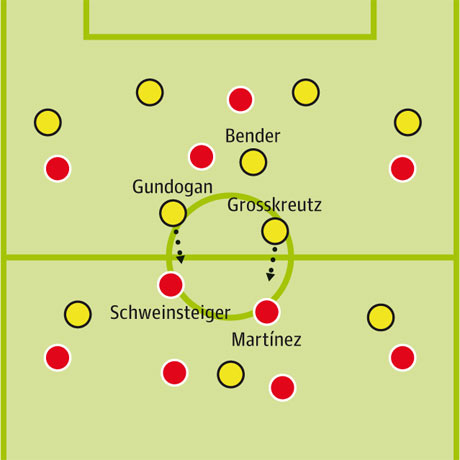
Dortmund v BayernDortmund have used a 4-3-3 against Bayern this season and pressed in midfield - Javi Martínez and Bastian Schweinsteiger could choose to battle energetically, or a play a calmer passing game. Illustration: Graphic
Last summer's purchase of Martínez was something of a gamble. The Basque holding midfielder had won the World Cup and the European Championship as a backup player, but meeting Athletic Bilbao's €40m buyout clause was a significant leap of faith in a player who had no Champions League experience, and a player who had spent the majority of the previous campaign playing at centre-back.
Martinez didn't know a word of German when he arrived in Bavaria, but found assistance from Schweinsteiger, who spoke a little Spanish and translated Heynckes' instructions during pre-season training. Just as Schweinsteiger helped Martinez settle linguistically, he assisted him in his tactical responsibilities too. "He helped me in the initial stages an immense amount, in terms of positioning in the midfield," says Martinez. Last season Bayern were too easily exposed on the counterattack, and conceded goals from unnecessary errors deep in midfield – yet that problem has been absent since Martínez's arrival.
Martínez describes himself as "the most German of all Spanish footballers", and while he remains a reliable passer, his strength and mobility has been particularly useful throughout the knockout stages of the Champions League. Delving through Martínez's commentary on each round, and each opponent, makes for interesting reading. Following the win over Arsenal at the Emirates, Martínez was happy with the way he and Bayern "stopped Arsenal from applying their quick passing game".
After the victory over Juventus, he boasted of Bayern's "increasing physical edge" over the Italian champions, a feature that was even more obvious against Barcelona in the semi-final, when Martínez had warned that it was "important to press and not give them time to think".
Much like the Barcelona side of Bayern's future coach, Pep Guardiola, Heynckes encourages his players to close down intensely. But whereas Barcelona's pressing was about positioning and energy, Bayern are capable of sheer force. Martínez's performance in the 4-0 first leg victory over Barcelona was extraordinary – his first job was nullifying Andrés Iniesta but his sheer power also drove Bayern forward and overwhelmed the Barcelona midfielders. He often controls the central midfield zone in the frenetic opening stages, before Schweinsteiger takes command when the tempo drops in the second half – and the German is fully appreciative of Martínez's impact. "Every day, we see more clearly how important his signing has been," Schweinsteiger said.
Arsenal, Juventus and Barcelona are patient passing sides but familiar foes Dortmund are an entirely different beast – they are a high-tempo, mobile team who excel at transitions, bursting forward suddenly. Jürgen Klopp has reformatted his midfield in meetings against Bayern this season, seemingly a reaction to Bayern's midfield improvement. Rather than his default 4-2-3-1 system, he has played a more cautious 4-3-3 which uses an extra-deep midfielder. Klopp usually orders his players to press in the opening stages against Bayern, so expect to see Ilkay Gundogan – who offers a mixture of physicality and technique Bayern will admire – get into the faces of Martínez and, in particular, Schweinsteiger, in the first few minutes.
Bayern's approach will be fascinating: they have always dominated possession against Dortmund in recent years, but now they are capable of overrunning Klopp's side in a fast-paced battle, too.
Bayern will be admirably compact and disciplined when Dortmund have possession – forwards Mario Mandzukic and Thomas Müller drop back and contribute without the ball – but Bayern's primary defensive task is to stop Dortmund's counterattacks. As well as preventing them playing forward quickly, Bayern are also capable of denying Dortmund opportunities to break in the first place, by retaining possession for long periods.
Having concentrated on pressing and destroying in the semi-final victory over Barcelona, Martínez and Schweinsteiger will now concentrate on passing and creating. That flexibility makes them a truly outstanding pairing.

Bayern Munchen v Borrusia Dortmund. Preview Match

From left: Neven Subotic and Arjen Robben

At the beginning of Champions League Round of 16, no one would have expected this year's final to be the first all-German showdown. The two rivals, Bayern Munich and Borussia Dortmund, edged past the Spanish giants in their respective semi-finals to set up the fourth UEFA Champions League final between teams from the same country.

While Germany's most prestigious club, Bayern Munich, was one the favorites to make the final this year, their arch-rivals Borussia Dortmund - who were tagged as underdogs in the tournament - have surprised everyone with their ferocious skills and talent.

Bayern Munich, valued at $1,309 million, are up against a team that is valued at a mere $456 million - a fact that has attracted a lot of support for Borussia Dortmund and irks the football big shots. The darlings of soccer nerds and people who dislike rich clubs, BVB have transformed themselves into giant killers from being just the underdogs.

The yellow German powerhouse faced their biggest test in the Champions League semi-finals against Real Madrid - one of the most successful clubs in the tournament's history. But, to everyone's surprise, BVB stunned the Spanish giants 3-2 on aggregate to make the tournament final.

On the other hand, Bayern Munich were able to dictate their terms against Barcelona during their semi-finals tie. Jupp Heynckes' men annihilated the Spanish superstars 7-0 on aggregate to announce their arrival at the tournament final.

After dominating the German Bundesliga for two years in a row, Jurgen Klopp's men lost the title to their arch-rivals Bayern Munich this season - a fact that makes this year's Champions League final more exciting.

While Bayern Munich have reportedly planned their Champions League victory party in advance - after booking the Great Room in the Grosvenor House Hotel with a buffet for 1,800 people and a bar extension to 5am, their track record in the tournament final speaks otherwise.

The Bavarians have reached ten European Cup/UEFA Champions League finals and have lost six of them with their most recent heartbreak against Chelsea last season. The last time Bayern won the title was back in 2001 against Valencia with 5-4 victory on penalties.

The Champions League final this year will be more than just about the silverware between these two wherein Borussia Dortmund will be looking to avenge their Bundesliga title defeat against Bayern Munich - who will be eyeing their fifth tournament title this season.

Star players from Borussia Dortmund:

Robert Lewandowski:The 24-year-old Polish footballer has been the livewire for Jurgen Klopp's squad out upfront. With 10 sensational goals for Dortmund, the hot-shot striker is the second top goal-scorer after Real Madrid's Cristiano Ronaldo in the Champions League this season. Lewangoalski also became the first player to score four goals in a Champions League semifinal during Dortmund's 4-1 win over Real Madrid 4-1 in the first leg. He is also the top goal-scorer in the Bundesliga this year with 25 goals for Dortmund.

Marco Reus: The 23-year-old German winger is known for his versatility, speed and technique. The 2012 Footballer of the Year in Germany has scored four goals for Dortmund in the Champions League this season. He instigated numerous Dortmund moves against Real Madrid in the semi-finals to sink the Spanish giants. Dortmund's young gun has also scored 14 goals for his side in the Bundesliga this year.

Star players from Bayern Munich:

Thomas Muller: The 23-year-old German star has been a goal-machine for Bayern Munich in the Champions League this season. With 8 goals to his name, Muller is placed third top goal-scorer right behind Borussia Dortmund's Robert Lewandowski in the Champions League this season. The winger has also scored 13 goals in the Bundesliga this season for Bayern.

Bastian Schweinsteiger:The 28-year-old German footballer is the key to Bayern Munich's midfield play. His capability to play out wide or in a more central role makes him an ideal player to have in your team. His backheel flick goal against Eintracht Frankfurt on April 6, 2013 sealed the Bundesliga title for Bayern Munich. Schweini scored a total of seven goals for Bayern in the Bundesliga this season.
Probable Line-up(from):

Bayern Munich: Neuer, Lahm, Boateng, Dante, Alaba, Javi Martinez, Schweinsteiger, Robben, Muller, Ribery, Mandzukic.

Borussia Dortmund:Weidenfeller, Piszczek, Subotic, Hummels, Schmelzer, Bender, Gundogan, Grosskreutz, Blaszczykowski, Reus, Lewandowski. 
Did You Know:

- Germany would become fourth country to have both its clubs featuring in the finals (Borussia Dortmund-Bayern Munich in 2013), after Spain (Real Madrid-Valencia CF in 2000), Italy (Milan-Juventus in 2003) and England (Manchester United FC-Chelsea FC in 2008).

- Borussia Dortmund were the first German club to win a European title when they won the UEFA Cup Winners' Cup in 1966.

- Bayern Munich have won four and lost three of seven UEFA competition ties against German rivals.

- Bayern Munich's victory would make Heynckes the 19th coach to have won the European Cup twice, following his 1998 success with Real Madrid.

- Bayern Munich's 2-5 loss against Borussia Dortmund in the 2012 DFB-Pokal final was their worst ever loss in a final.

- The rivalry between Borussia Dortmund and Bayern Munich reached to a new height when Dortmund edged past Bayern on a 1-0 aggregate in the 1998 UEFA Champions League quarter-finals.

- In 2002, manager Matthias Sammer became the first person in Borussia Dortmund history to win the Bundesliga as a player and manager with their third Bundesliga title.

- Borussia Dortmund are one of four German clubs to win the Bundesliga and DFB-Pokal double along with Bayern Munich, 1. FC Koln, and Werder Bremen.

- Borussia Dortmund and Bayern Munich were carded a record of 15 times in a match played on 7 April 2001.

- Borussia Dortmund's Robert Lewandowski became the first player to score four goals in a Champions League semifinal where Dortmund thrashed Real Madrid 4-1 in the first leg.

William Fancies Bayern Munich To Win Euro Soccer League


Soccer fan Prince William said today that he fancied Bayern Munich to win Saturday's all-German Champions League final against Borussia Dortmund.
"My money is on Bayern Munich and two-nil," Prince William said.
168809726LG00001_UEFA_CHAMP
President of The FA Prince William, Duke of Cambridge is presented a match ball by UEFA President Michel Platini during the UEFA Congress at the Grovesnor House Hotel (Laurence Griffiths / Getty Images)
He was speaking at an event to welcome soccer officials from across Europe for Uefa's 37th annual congress being staged in London today.
William, who is president of the British Football Association, told delegates: "It is a great honour for us, the English FA, to host not just this prestigious Congress, but of course - the real excitement - tomorrow's Champions League final. My money is on Bayern Munich and two-nil. To host these events during our 150th anniversary year is truly special.
"The rules of association football were drafted 150 years ago in a London pub very close to where we meet today. As you know, we English have a love affair with both football and our pubs, so it's no surprise that one helped create the other."
In his speech, FIFA president Sepp Blatter said: "We have had the honour of listening to Prince William, a fan of Aston Villa who have been fighting relegation, but they did it!"
It was the first time the Duke has met Blatter since the royal played a role in England's unsuccessful bid to host the 2018 World Cup, joining a delegation in Switzerland in 2010 which included David Cameron and David Beckham.
Tomorrow, Wembley Stadium in London hosts the showpiece Uefa Champions League final between Germany's two leading teams Borussia Dortmund and Bayern Munich.
168809726LG00003_UEFA_CHAMP
President of The FA Prince William, Duke of Cambridge is presented a match ball by UEFA President Michel Platini during the UEFA Congress at the Grovesnor House Hotel (Laurence Griffiths / Getty Images)

THE LEFT-BACKS: DAVID ALABA


Munich - One final, two Bundesliga clubs, 22 gladiators: These 'heroes of Wembley' will determine who wins the UEFA Champions League final 2012/13 between Borussia Dortmund and Bayern Munich in London on Saturday, 25 May.
bundesliga.com outlines the careers and key facts of the protagonists.

Career details


David Alaba was born on June 24, 1992 in Vienna. The son of a Filipino mother and Nigerian father, Alaba climbed his first steps on the footballing ladder when he left local side Club SV Aspern to join FK Austria aged just ten. An aspiring forward at the time, Alaba made the dream move to FC Bayern Munich in the summer of 2008. Former Bayern coach Louis van Gaal spotted Alaba’s true potential as a roaming left-back and, two years later, the Austrian celebrated not only his Bundesliga debut in the 1-1 draw at 1.FC Koln, but went on to become the youngest ever player to feature for the record titleholders in the Champions League. An invaluable loan spell at 1899 Hoffenheim followed, as did a regular place in the international side, with the 2011 and 2012 Austrian Player of the Year having been capped 24 times to date.

Key facts


• Alaba has made ten appearances in this season’s Champions League - eight at left-back and two in midfield - scoring twice and chipping in with two assists.

• He scored the fifth-fastest goal in Champions League history to set FC Bayern Munich on their way to a commanding 2-0 victory over Juventus in their quarter-final first leg at the Allianz Arena.

• Alaba set up a goal in both semi-final legs against FC Barcelona.

• He clocked up 752 minutes of action before committing his first foul.

• In the 2011/12 semi-final second leg against Real Madrid, Alaba displayed nerves of steel as he fired home the first spot-kick in the decisive shootout. Unfortunately for Bayern, he missed the final against Chelsea through suspension. 

THE CENTRE-BACKS: DANTE


Munich - One final, two Bundesliga clubs, 22 gladiators: These players will determine the outcome of the 2012/13 UEFA Champions League decider between Borussia Dortmund and Bayern Munich at Wembley Stadium on 25 May.
bundesliga.com outlines the careers and key facts of the protagonists.

Career details


Born on October 18, 1983 in Salvador da Bahia, Brazil, Dante Bonfim Costa Santosstarted out on the path to stardom at EC Juventude in Caxias do Sul. He made the move to Europe as a 20-year-old and, following stints at Lille, Charleroi and Standard Liege (with whom he won the Belgian league in 2007/08), switched to Bundesliga outfit Borussia Monchengladbach in January 2009. Returning to fitness following an ankle injury, Dante quickly became a household name at Borussia Park, with the Foals staving off relegation one year and notching a fourth-place finish the next. That was enough to convince Bayern, who made their move for the unmistakable Samba star in the summer of 2012. Dante has featured 28 times in the Bundesliga this season and made his long-awaited international debut against England on Feburary 6, 2013. 

Key facts


  • In Dante’s first season of Champions League football, the 29-year-old has featured in eleven of Bayern’s twelve fixtures (ten starts). He sat out the semi-final second leg with a cold.
  • The Brazilian has come out on top in 67 per cent of his man-on-man tussles in the Champions League, compared to 62 per cent in the Bundesliga.
  • Dante has one Champions League assist to his name, laying on the opening goal for Thomas Müller in the 4-0 first leg win over Barcelona.
  • He won 86 per cent of his tackles in the first leg against Barcelona, with Lionel Messi not once getting the better of the Brazil international. 

THE CENTRE-BACKS: JEROME BOATENG


Munich - One final, two Bundesliga clubs, 22 gladiators: These 'heroes of Wembley' will determine who wins the UEFA Champions League final 2012/13 between Borussia Dortmund and Bayern Munich in London on Saturday, 25 May.
bundesliga.com outlines the careers and key facts of the protagonists.

Career details


Tennis Borussia Berlin, Hertha BSC, Hamburger SV, Manchester City and FC Bayern Munich: not many 24-year-olds boast a CV quite like that of Jerome Boateng. A striker in his early days, Boateng made the successful transition to defensive stalwart at Hertha, with whom he won the U-17 championship. At 18, he made his professional debut for the capital club, before moving to Hamburg six months later. A further three years and 75 Bundesliga appearances down the line, Boateng jumped ship to ambitious English Premier League outfit Manchester City. Unable to settle, in part due to a spate of injuries, the son of a Ghanaian father and German mother returned to his homeland in 2011 with Bayern Munich. He quickly adjusted to the Bavarian way of life and the Bayern back four, playing his part in all 13 of the club's Champions League games last term.

In a World Cup qualifier in 2009, Boateng became the first ever Germany player to be sent off on his international debut, but with that slip-up behind him has since established himself as a regular in the side.

Key facts


  • Boateng has had a quiet season by his standards, averaging just ten challenges per game.
  • Boateng has won 67 per cent of his aerial tussles, compared to just 54 per cent on the ground.
  • Boateng’s passing game has really impressed, with only nine per cent of his attempted passes failing to find a team-mate.